


Build stronger post-mastectomy client relationships with recurring fit checks, annual reassessments, education, and medically necessary product reviews.
Table of Contents
The Appointment Should Not End at the Checkout Counter
A well-fitted breast prosthesis or mastectomy bra can immediately improve comfort, symmetry, mobility, and daily function. But the fitting itself is only one moment in a much longer continuum of post-mastectomy care.
Post-mastectomy needs are dynamic.

Bodies change. Treatment plans change. Weight fluctuates. Tissue characteristics evolve. Activity levels shift. Garments stretch and wear. Prostheses may no longer provide the balance or comfort they once did. A client who was perfectly fitted 18 months ago may have an entirely different set of needs today.
This is the basis of medical necessity.
This reality creates an important opportunity for post-mastectomy boutiques: make follow-up part of the service model rather than an afterthought.
A recurring relationship built around annual reassessments, periodic fit checks, product reviews, education, and priority scheduling can transform a boutique from a place where patients purchase products into a trusted destination for continuing post-mastectomy support.
The key, however, is maintaining an essential distinction: the ongoing service model should remain grounded in clinical need and medical necessity.
That distinction protects the client, strengthens professional credibility, and supports responsible reimbursement practices.
From Transaction to Continuum of Care
The second model recognizes that post-mastectomy needs are dynamic.
This does not mean every client needs a product every time they walk through the door. In fact, a strong recurring-care model should make that explicit.
A quarterly fit check might reveal that the current bra remains appropriate. An annual reassessment might confirm that the existing prosthesis continues to meet the client’s needs. A seasonal review might identify an activity-related concern but not justify a new covered item.
That is still a successful appointment.
The value is in identifying needs early, documenting appropriately, providing education, and maintaining continuity.
Why Annual Reassessment Matters
An annual reassessment can become the anchor of a boutique’s ongoing relationship with a client.
Bodies change. Treatment plans change. Weight fluctuates.
The appointment should be more than a quick measurement. It can provide an opportunity to evaluate:

- Current prosthesis fit and positioning
- Bra fit, support, and condition
- Changes in body weight or contour
- Changes following surgery or treatment
- Skin integrity and areas of pressure or irritation
- Comfort during normal daily activities
- Changes in activity level
- Changes in the client’s functional needs
- Whether existing products remain appropriate
- Whether a different product type may be medically indicated
- Questions or concerns the client has developed since the previous visit
The reassessment also provides an opportunity to reinforce self-management education.
Client’s may have forgotten how to:
- properly position a prosthesis
- recognize signs of an ill-fitting garment
- care for specialized fabrics
- determine when a product has reached the end of its useful life.
A recurring appointment makes education part of the relationship rather than something delivered only during the initial fitting.
Quarterly Fit Checks: Small Interventions, Big Value
Quarterly appointments do not necessarily need to be lengthy.
A brief Fit Check can function as a proactive touchpoint. The objective is not automatically to sell something. It is to identify changes before they become significant problems.
A quarterly visit might include a structured review:
Fit: Is the prosthesis still sitting correctly?
Comfort: Is there rubbing, pressure, pulling, shifting, or discomfort?
Garment condition: Has the bra stretched, lost support, or developed functional problems?
Function: Is the patient experiencing difficulty with movement, exercise, work, or daily activities?
Body changes: Has there been a significant change since the last assessment?
Concerns: Has anything changed that warrants a more comprehensive reassessment?
For the boutique, these brief encounters accomplish something strategically important: they maintain an active relationship without turning every interaction into a sales event.
That distinction can become a competitive advantage.
Seasonal Product Reviews Add Practical Value
Seasonal changes naturally create opportunities for reassessment.
Summer may bring increased perspiration, outdoor activity, travel, and different clothing choices. Winter may introduce heavier garments, layering, and different support requirements.
Rather than framing seasonal appointments as opportunities to sell seasonal merchandise, boutiques can position them as seasonal comfort and function reviews.
Examples might include:
1. Spring Fit + Activity Review
Evaluate comfort as the client becomes more active outdoors, travels, gardens, exercises, or participates in recreational activities.
2. Summer Comfort Review
Discuss moisture management, fabric care, activity-related fit concerns, and garment performance.
3. Fall Wardrobe Review
Evaluate how current bras and prostheses work with changing clothing styles and layering.
4. Winter Comfort Review
Address layering, support, garment condition, and comfort beneath heavier clothing.
Products may appropriately enter the conversation—but only when there is a documented need for them.
5. Education Is Part of the Relationship
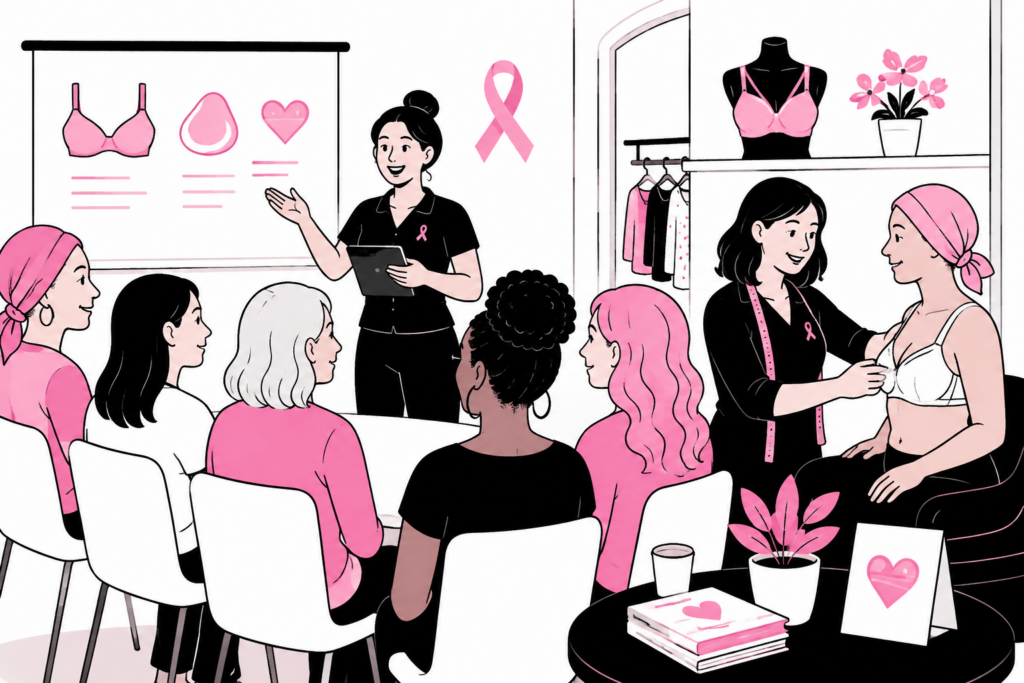
Educational sessions can become another important component of a recurring service model.
A boutique might offer small-group or one-on-one educational opportunities covering topics such as:
- Prosthesis care and maintenance
- Bra care and replacement considerations
- Recognizing changes in fit
- Skin protection
- Travel preparation
- Exercise and activity considerations
- Clothing and wardrobe strategies
- Understanding product features
- When to request a professional reassessment
- Communicating fit concerns to healthcare providers
These sessions strengthen the boutique’s identity as a healthcare resource.
They also create natural opportunities for patients to return between major product purchases.
That matters because relationship frequency and product frequency do not have to be the same thing.
A patient might attend three educational sessions during a year and purchase nothing. That patient can still become a loyal advocate, referral source, and long-term client.
Pre-scheduled Appointments: Rewarding Continuity Without Creating Barriers
Another possible feature is a priority scheduling system for established patients.
Pre-scheduled appointments might provide existing clients with:
- Earlier access to fitting appointments
- Reserved reassessment times
- Same-week fit-check opportunities when available
- Special educational-event invitations
- Advance notification of new educational programs
- Dedicated appointment blocks during high-demand periods
The critical issue is how this is positioned. The clinical service remains available based on need. The scheduling experience simply recognizes established patients.
The Medical Necessity Guardrail
This is where recurring service models require discipline.
Medicare’s current guidance states that external breast prostheses and related supplies are covered when reasonable and necessary for eligible patients following mastectomy. The Centers for Medicare and Medicaid Services (CMS) also emphasizes documentation, correct coding, written orders, and proof of delivery.
CMS specifically notes that a breast prosthesis is covered for a patient who has had a mastectomy and provides coverage criteria for certain mastectomy bras and prostheses.
The practical lesson for boutiques is straightforward:
- The appointment schedule can be recurring.
- Medical necessity cannot be manufactured by any appointment schedule.
- An annual appointment does not automatically make a new prosthesis medically necessary.
- A quarterly visit does not automatically justify a new bra.
- A seasonal review does not automatically create a billable event.
Instead, each product recommendation should be connected to the patient’s actual circumstances, applicable coverage criteria, appropriate documentation, and payer requirements.
CMS also publishes useful replacement guidance. For example, its current Medicare educational material identifies different reasonable useful lifetimes for certain prosthetic products and explains circumstances in which replacement may or may not be covered.
That makes documentation particularly important.
Document the Clinical Story, Not Just the Sale
A recurring-care model works best when documentation reflects the patient’s changing clinical and functional circumstances.
Instead of documenting only:
“Patient purchased new bra.”
The record should capture the relevant assessment that supports the recommendation.
For example:
- What changed?
- What was assessed?
- What problem was identified?
- How does the current product perform?
- What functional or medical issue exists?
- Why is the recommended product appropriate?
- What education was provided?
- What follow-up was recommended?
This approach creates a clinical narrative rather than a retail transaction. It also reinforces the professional role of the fitter.
CMS notes that documentation created by an orthotist or prosthetist can be considered part of the medical record for purposes of supporting documentation related to medical necessity under applicable federal provisions.
The precise documentation and billing requirements vary by payer, product, and circumstance, so boutiques should maintain current payer-specific policies and avoid assuming that Medicare rules automatically apply to every insurer.
A Recurring Model Can Actually Improve Patient Experience
Patients should not have to wonder:
- “Is this normal?”
- “Does my bra still fit correctly?”
- “Is my prosthesis supposed to feel like this?”
- “When should I be reassessed?”
A structured follow-up model gives patients a predictable pathway back to professional guidance.
That predictability can be especially valuable after major life events, additional treatment, reconstruction changes, weight changes, or lifestyle transitions.
The boutique becomes familiar territory.
The fitter becomes a consistent professional resource.
And the patient does not have to wait until a problem becomes uncomfortable enough to force an appointment.
The Business Case: Lifetime Value Over One-Time Sales
From a business perspective, recurring relationships can produce a healthier revenue model than constantly searching for new customers.
The objective is not to extract more purchases from an existing patient. It is to increase lifetime relationship value by providing useful services throughout the patient’s post-mastectomy journey.
A patient who returns periodically is more likely to:
- Remain connected to the boutique
- Seek professional advice before purchasing elsewhere
- Refer friends or family members
- Participate in educational programs
- Return when a medically necessary product is needed
- Develop trust in the fitter’s recommendations
- Become familiar with the boutique’s broader services
This is particularly important for independent boutiques competing against large retailers and online sellers.
An online retailer can sell a bra.
It cannot easily replicate a trusted professional who remembers the patient’s fitting history, understands her preferences, recognizes changes in fit, and provides personalized education.
The relationship becomes the differentiator.
Designing the Fit + Follow-Up Calendar
A boutique could organize its service model around a simple annual rhythm:
Quarter 1: Annual comprehensive reassessment
Quarter 2: Fit and comfort check
Quarter 3: Seasonal activity and product review
Quarter 4: Fit check, education, and preparation for the next annual reassessment
Educational sessions can be incorporated throughout the year.
Patients do not necessarily need to receive the same schedule. Clinical circumstances should determine follow-up frequency.
Some patients may need more frequent attention. Others may need only an annual reassessment unless a concern develops.
That flexibility is important.
The model should be structured enough to create continuity but individualized enough to remain clinically credible.
The Future of the Post-Mastectomy Boutique
The strongest post-mastectomy boutiques may increasingly operate less like specialty retailers and more like longitudinal care environments. This means recognizing that fitting is not a single transaction.
A patient’s body, lifestyle, treatment history, comfort, activity level, and functional needs can evolve. A professional fitting relationship should be capable of evolving with them.
The most compelling service model is therefore not:
“Come back when you need another product.”
It is:
“We remain available to assess, educate, fit, and support you as your needs change.”
That is a fundamentally different value proposition.
It builds loyalty without manufacturing demand. It creates meaningful client touchpoints without turning every appointment into a sales opportunity. And when a product is genuinely needed, the boutique is already there—prepared to document the need, identify an appropriate solution, and provide professional service.
The future may belong to boutiques that stop measuring success solely by the number of products sold and start measuring the strength of the relationships they maintain.
Fit once. Follow up. Reassess. Educate. Support.
That is how a post-mastectomy boutique can turn a fitting into a continuing care relationship—while keeping medical necessity at the center of every appropriate product decision.