


Post-mastectomy fittings are rarely “routine.” For many patients, the fitting room is not just a retail or clinical environment — it is an emotionally loaded space where identity, health history, grief, and recovery intersect.
Professional mastectomy fitters occupy a uniquely trusted role at this juncture. You are part clinician, part educator, and part emotional anchor. Integrating trauma-informed care into your fitting practice strengthens outcomes, builds trust, and reinforces the professionalism of our field.
Trauma-informed care is not therapy. It is a framework that prioritizes emotional safety, autonomy, and respectful communication in the fitting room, while recognizing that many patients carry medical, surgical, and psychosocial trauma related to cancer treatment.
These are measured moments. Here are best practices for communication, consent, emotional safety, and supporting patients coping with body image changes after mastectomy.
Table of Contents
Understanding Trauma in the Post-Mastectomy Population
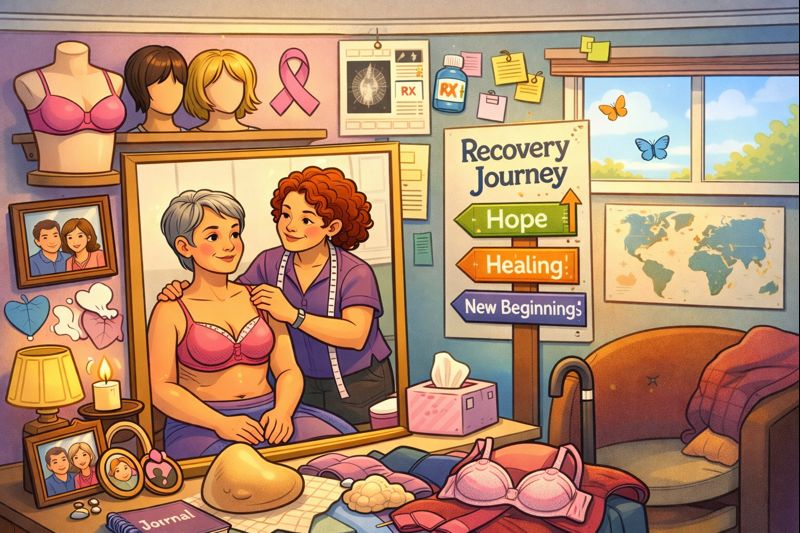
Trauma does not always look dramatic. It may present as guarded behavior, difficulty making decisions, excessive apologizing, dissociation, or heightened sensitivity to touch. Patients may be navigating:
- Surgical trauma
- Complicated recoveries
- Loss of bodily autonomy during treatment
- Changes in sexuality or self-image
- Anxiety about recurrence
- Medical PTSD or procedure-related fear
Even patients who appear upbeat may feel vulnerable when undressing, being measured, or discussing their chest wall. A trauma-informed mindset assumes that emotional sensitivity is present, whether disclosed or not.
The core principles to guide your practice are:
- Safety
- Choice
- Collaboration
- Trustworthiness
- Empowerment
These principles should shape every interaction in the fitting room.
Creating Emotional and Physical Safety
Before a single garment is introduced, the environment itself communicates safety.
Prepare the Space

A trauma-informed fitting room should be:
- Private, quiet, and interruption-free
- Warm and physically comfortable
- Free from mirrors until the patient is ready
- Stocked with soft draping garments or robes
- Equipped with seating that supports slow pacing
Avoid rushing. A hurried environment increases stress responses and reduces the patient’s ability to process information.
Set Expectations Early
Start each appointment with orientation. Uncertainty can trigger anxiety.
Try language such as: “I’ll walk you through each step, and you can stop or pause at any time. You’re in control throughout the fitting.” This establishes predictability and restores a sense of autonomy that may have been lost during medical treatment.
Communication That Reduces Vulnerability
Words matter deeply in the fitting room. Clinical precision should be paired with warmth and neutrality.
Use Body-Neutral Language
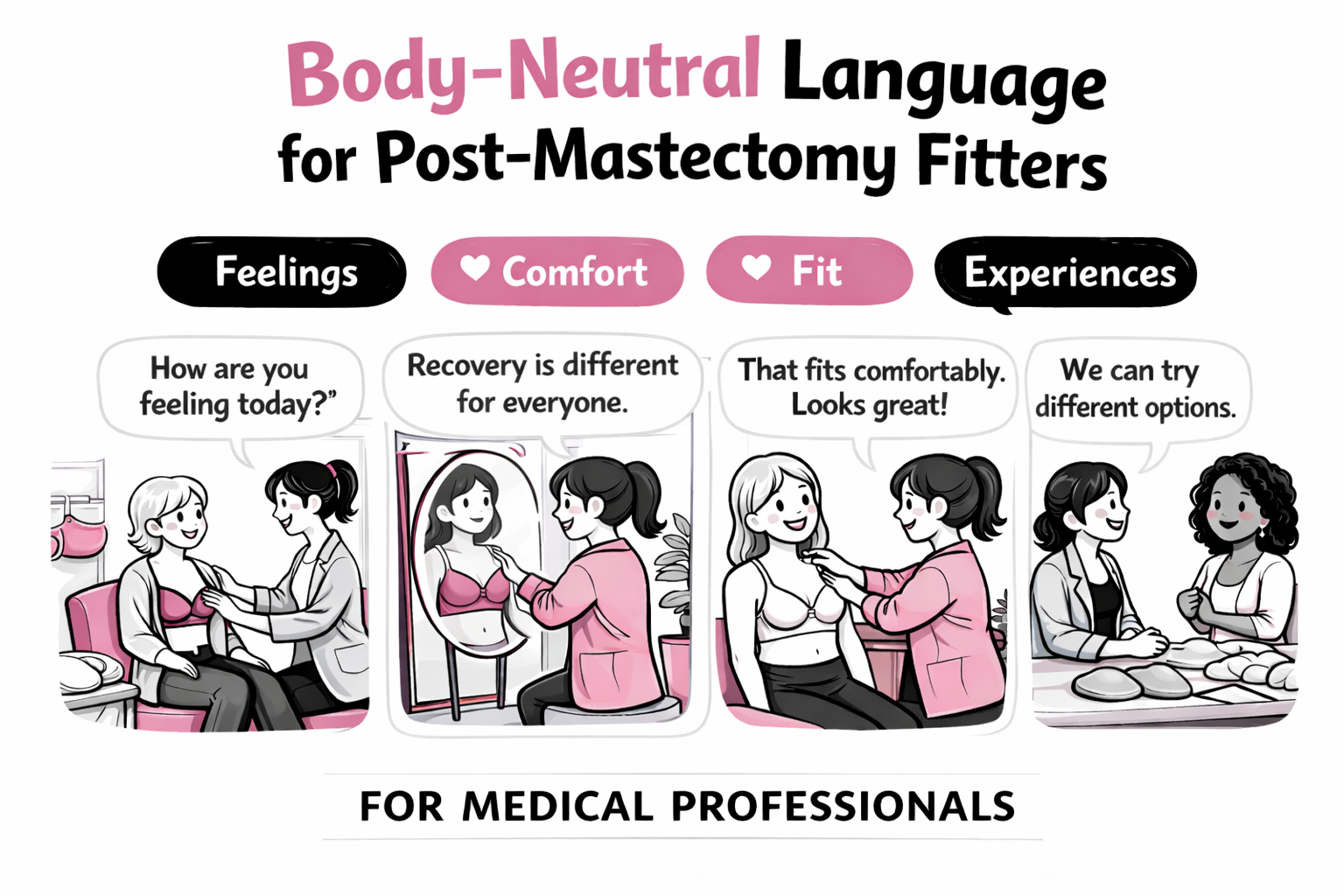
Avoid phrases that imply deficiency, such as “fix,” “replace,” or “make you look normal.”
Instead, use:
- “balance”
- “symmetry”
- “support”
- “comfort”
- “options”
This reframes the fitting as an enhancement and a source of support rather than a correction.
Follow the Patient’s Lead
Mirror the terminology the patient uses for their body. Some prefer “breast,” others “chest,” “site,” or “scar area.” Adopting their language signals respect and psychological attunement.
Normalize Emotional Responses
If a patient becomes tearful or quiet, avoid overreacting. Gentle normalization can reduce shame:
“Many people find this part emotional. Take your time — we can go at your pace.”
This validates feelings without pathologizing them.
Consent Is an Ongoing Process
In trauma-informed care, consent is active, specific, and continuous. It is not a one-time question.
Ask Before Every Touch
Even routine measuring should be preceded by permission:
“Is it okay if I place the tape here along your ribcage?”
This small step restores bodily autonomy and reduces startle responses.
Offer Alternatives
Provide options whenever possible:
- “Would you like to measure standing or seated?”
- “Would you prefer to look in the mirror now or later?”
- “Would you like me to stay while you change, or step out?”
Choice reduces power imbalances and fosters collaboration.
Watch Nonverbal Cues
Even in the privacy of the fitting room, consent can be withdrawn nonverbally.
Signs of distress may include:
- Holding breath
- Freezing or going quiet
- Pulling away
- Avoiding eye contact
Pause immediately and check in with a simple phrase that puts the patient back in control: “Would you like a break?”
Supporting Patients Through Body Image Changes
Body image after mastectomy is complex. Some patients want symmetry; others embrace asymmetry. Your role is not to direct the outcome, but to support their goals.
Avoid Assumptions
Do not assume that:
- Reconstruction is desired
- A full form is preferred
- Symmetry equals emotional readiness
Instead, ask open-ended questions:
- “What feels most important to you in how clothing fits now?”
- “How do you want to feel when you get dressed?”
This centers on function and emotion rather than appearance alone.
Introduce Options Gradually
Overloading a patient with multiple forms, sizes, and styles can be overwhelming. Present one or two choices at a time and explain the differences clearly. Trauma can affect decision-making under stress, so pacing matters.
Respect Grief and Identity Shifts
A patient may be mourning a part of their body while also celebrating survival. Hold space for both realities without trying to “cheerlead” away difficult feelings.
Avoid toxic positivity like “At least you’re healthy.”
Instead, try: “This is a big change. It makes sense that it brings up a lot.”
Managing Emotional Moments Professionally
Even with significant experience, most certified mastectomy fitters are not licensed counselors. However, with the fitting room, it is highly likely that emotional moments will arise.
Use Grounding Techniques
If a patient (or a mastectomy fitter) becomes overwhelmed grounding techniques can be easily incorporated into the conversation:
- Encourage slow breathing
- Invite them to feel their feet on the floor
- Offer water
- Suggest a brief pause
These simple techniques can help regulate the nervous system and minimize situational stress.
Maintain Professional Boundaries
Empathy does not require self-disclosure or physical comforting unless clearly appropriate and consented to. A calm, steady presence is often more regulating than intense emotional engagement.
Know When to Refer
If a patient expresses persistent distress, hopelessness, or difficulty coping, gently suggest additional support:
- “Many people find it helpful to talk with an oncology counselor. I can share some resources if you’d like.”
- This is supportive, not intrusive.
Building Trust Through Transparency
The mastectomy fitting room can be an uncertain environment. Trust is strengthened when patients understand what you are doing and why.
Explain:
- Why certain measurements matter
- How different forms affect posture and comfort
- What sensations are normal vs. concerning
Knowledge reduces fear and positions you as a collaborative partner rather than an authority figure making decisions for them.
Empowerment at the End of the Appointment
The close of the fitting is an opportunity to reinforce confidence.
Summarize positively:
- “You chose options that prioritize comfort and how you want clothing to drape. That’s a great foundation, and we can adjust anytime.”
- This reinforces agency and keeps the door open for follow-up.
Encourage gradual adjustment:
- “Wear this at home first for a few hours. Your body will tell you what feels right.”
- This respects the adaptation process.
Why Trauma-Informed Care Elevates the Profession
Trauma-informed practice is not an “extra.” It is a marker of advanced professionalism in post-mastectomy fitting.
It leads to:
- Greater patient trust
- Improved long-term compliance with garments
- Fewer returns due to emotional discomfort rather than fit issues
- Stronger referrals from healthcare providers
Most importantly, it honors the lived experience of the people we serve.
In the fitting room, technical skill and emotional intelligence are inseparable. When patients feel safe, respected, and in control, the fitting becomes more than a product selection — it becomes a step toward reclaiming comfort, confidence, and autonomy after profound change.