


Is speaking in the third person a savvy branding move or a red flag? Explore how illeism shapes leadership, trust, and perception in post-mastectomy businesses.
Table of Contents
Illeism: Smart Strategy or Entrepreneurial Ego?
If you have spent any time around founders, consultants, or high-performing entrepreneurs, you may have noticed a curious linguistic habit: referring to oneself in the third person. “The company believes…” or “Jane prioritizes patient-centered care…” This rhetorical device, known as illeism, has quietly moved from political speeches and celebrity interviews into the language of business leadership.
But in a field as intimate and trust-driven as post-mastectomy care, the question is not just whether illeism is stylistically interesting—it is whether it is effective, appropriate, or even ethical. Does it signal confidence and strategic clarity, or does it veer into self-aggrandizing “bossism” that alienates patients and peers?
What Is Illeism, Really?
Illeism is the practice of referring to oneself in the third person rather than using first-person pronouns.
Historically, it has been used by figures attempting to project authority, objectivity, or even legacy. In modern business contexts, it often appears in branding language, mission statements, and leadership communication.
In healthcare, think of the questions doctors often ask, “How are we feeling today?”
From a psychological standpoint, illeism can create cognitive distance. Research suggests that speaking about oneself in the third person may enhance emotional regulation and decision-making by encouraging a more objective perspective.
In theory, this could be beneficial for entrepreneurs navigating complex operational and ethical landscapes.
Pros and Cons of Illeism
Speaking about oneself or one’s business in the third person can be beneficial, creating a distance or subtly acknowledging that the company is its own entity.
It can show or support:
Emotional Detachment: Referring to oneself in the third person might create a sense of emotional detachment. By using one’s name or a third-person pronoun, individuals could distance themselves from the situation, allowing for a more objective perspective when making decisions. This could help reduce the influence of emotions and biases on decision-making.
Self-Reflection: Speaking about oneself in the third person could encourage self-reflection. It might feel as if you are analyzing the decisions of another person, which could lead to a deeper examination of motivations, goals, and potential consequences. This self-reflection could result in more thoughtful and deliberate decision-making.
Enhanced Accountability: The use of illeism might create a heightened sense of accountability. When making decisions, individuals might feel more responsible for their choices when talking about them in the third person. This could lead to more responsible and well-considered decisions.
Clarity and Objectivity: Speaking about oneself in the third person could help organize thoughts and communicate decisions more clearly. It could encourage individuals to provide logical reasoning and explanations for their choices, leading to better communication with others and a more structured decision-making process.
Reduced Impulsivity: The practice of illeism reduces impulsivity in the decision-making process by adding an extra layer of cognitive processing. This could help mitigate impulsive decisions and allow individuals to think through their options more thoroughly.
Meta-Cognition: Illeism could promote meta-cognition, which is thinking about one’s own thinking process. When using illeism, individuals might be more aware of their cognitive biases, assumptions, and mental shortcuts, leading to more accurate and informed decisions.
The Case for Illeism as a Strategic Tool
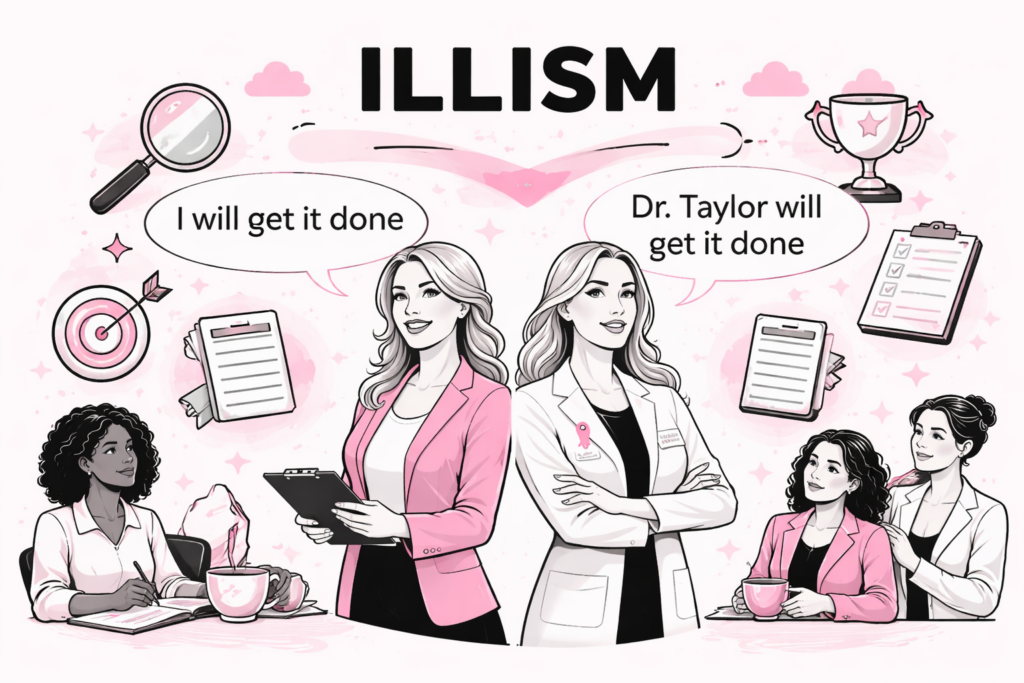
In certain contexts, illeism can function as a subtle but powerful branding mechanism. For post-mastectomy businesses, where professionalism and clarity are paramount, third-person language can:
Reinforce Brand Identity
Using the business name instead of “I” or “we” can shift focus from the individual to the organization. This is particularly useful for solo practitioners transitioning into scalable enterprises. “XYZ Fitting Services prioritizes compassionate care” feels more institutional than “I prioritize compassionate care,” even if both statements are true.
Create Perceived Objectivity
Third-person language can signal that decisions are guided by standards, protocols, and best practices rather than personal preference. In a field governed by insurance requirements, clinical considerations, and patient sensitivity, this framing can enhance credibility.
Support Boundary-Setting
Post-mastectomy fitters often navigate emotionally charged interactions. Illeism can serve as a linguistic boundary, helping professionals maintain empathy without over-identifying. For example, “The clinic requires documentation for all fittings” may feel less personal—and therefore less confrontational—than “I need you to provide documentation.”
In these scenarios, illeism is not about ego; it is about structure, scalability, and clarity.
When Illeism Becomes “Bossism”
The line between strategic language and performative authority is thin. Illeism can quickly backfire when it appears disconnected from authenticity or when it centers the entrepreneur rather than the patient.
Overpersonalization of the Brand
Statements like “Ms. Smith only delivers the highest level of excellence” can feel self-congratulatory, particularly if not supported by visible outcomes or credentials. In a profession built on trust, patients are less interested in proclamations and more interested in proof.
Erosion of Relational Trust
Post-mastectomy care is deeply personal. Patients are navigating physical recovery, identity shifts, and emotional vulnerability. Language that feels overly formal or self-referential can create distance at precisely the moment when connection is most needed.
Perception of Hierarchy Over Empathy
Illeism can unintentionally signal a top-down dynamic, where the practitioner is positioned as an authority figure rather than a collaborative partner in care. This is especially problematic in fittings, where patient feedback and comfort are central to successful outcomes.
In these cases, illeism is no longer a tool—it becomes a barrier.
Industry Context Matters
Unlike tech startups or corporate consulting firms, post-mastectomy businesses operate at the intersection of healthcare, retail, and emotional support. Communication is not just branding—it is part of the care experience.
Patients are not just consumers; they are individuals seeking restoration, dignity, and confidence. This shifts the calculus. Language choices must prioritize:
- Clarity over cleverness
- Empathy over authority
- Trust over positioning
Illeism can align with these priorities—but only when used intentionally and sparingly.
A 4 Point Practical Framework
Rather than adopting or rejecting illeism wholesale, consider a context-driven approach:
1. Use 1st Person Language in Patient Interactions
Statements like “I’m here to help you find the best fit.” foster immediacy and trust. They also signal presence and accountability.
2. Use 3rd Person Language in Formal Business Materials
Websites, policy documents, and insurance communications may benefit from a more structured tone. “The practice complies with Medicare guidelines,” reads as professional and standardized.
3. Avoid Self-Reference in Personal Branding
On social media or in community engagement, authenticity tends to outperform formality. Speaking directly to yourself can humanize your brand and strengthen relationships.
4. The Subtle Power of Language in Post-Mastectomy Care
Language does more than convey information—it shapes perception. In post-mastectomy care, it can influence how patients feel about their bodies, their recovery, and their choices.
Illeism, when used thoughtfully, can support professionalism and operational clarity. But when overused or misapplied, it risks introducing distance where closeness is essential.
Ultimately, the most effective practitioners are not those who sound the most authoritative, but those who communicate with precision, authenticity, and empathy.
So, Savvy or Bossy?
The answer is: it depends.
Illeism is neither inherently strategic nor inherently problematic. It is a tool—one that can either elevate your business communication or detract from it, depending on how it is deployed.
For post-mastectomy boutique owners, the guiding principle should be alignment.
- Does your language reflect your values?
- Does it support your patients’ experience?
- Does it enhance clarity without sacrificing connection?
If the answer is yes, then illeism may have a place in your communication toolkit. If not, it may be time to return to a simpler, more direct approach—one that centers the patient, not the persona.